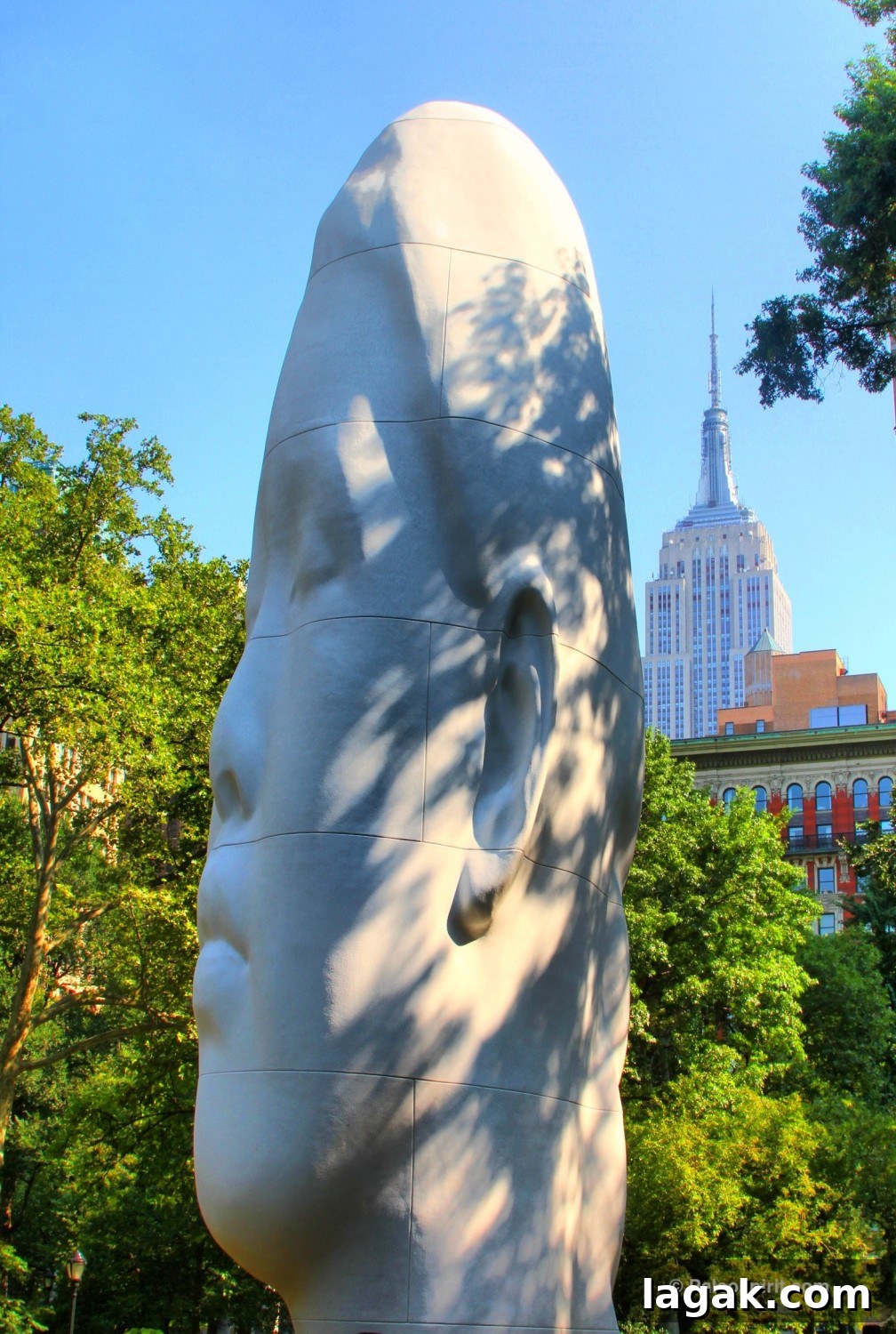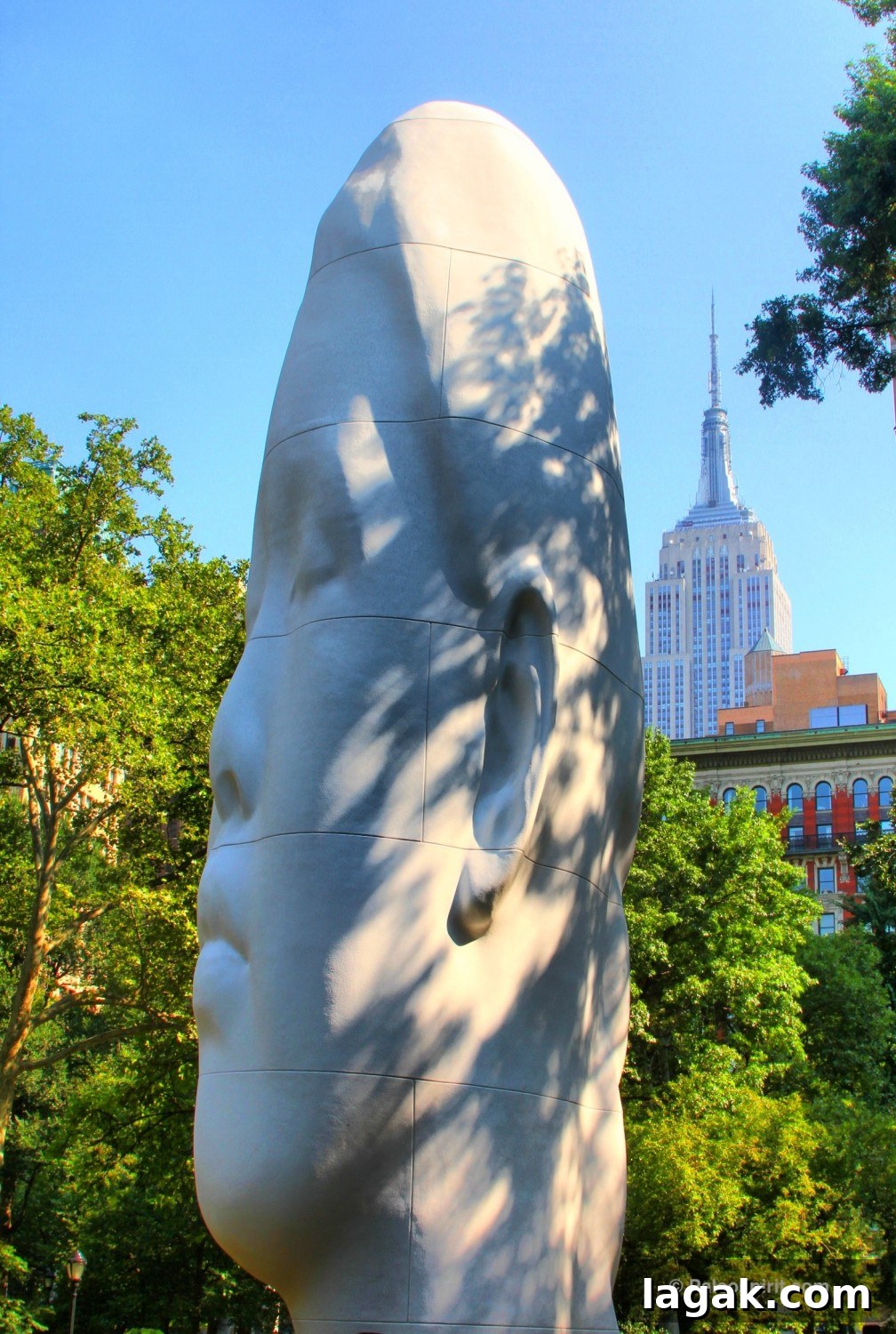
A monumental head sculpture by the acclaimed Spanish artist Jaume Plensa stands in Madison Square Park in New York City, framed against the iconic silhouette of the Empire State Building. Titled “Echo,” this 44-foot-tall white fiberglass resin piece takes its name and inspiration from the Greek mythological nymph Echo, who could only repeat the words of others and never speak for herself. Plensa’s oversized interpretation evokes both the voice and silence of that mythic figure, while its scale and presence recall Echo’s origin as a mountain nymph—large in spirit and rooted in landscape.
Plensa is known for his contemplative public works that combine figurative form, pattern, and serene expression. “Echo” continues this approach: its calm, closed-mouth visage encourages viewers to pause, reflect, and consider presence and absence in a bustling urban environment. The sculpture’s smooth, pale surface contrasts with the surrounding cityscape, creating a quiet focal point amid the vertical energy of Manhattan. From many vantage points in the park and along nearby streets, the head reads as both monumental and intimate, inviting different interpretations depending on the viewer’s distance and perspective.
Conceptually, Plensa often explores language, memory, and identity. In “Echo,” the idea of repetition and response is subtly implied by the sculpture’s placement and its relationship to the city’s architecture. Against the Empire State Building, a symbol of New York’s history and ambition, the serene, timeless face suggests reflection rather than rhetoric. The sculpture does not shout to be noticed; instead, it offers a pause in the city’s constant flow, a place where sound and silence can be imagined together.
The material choice—fiberglass resin finished in white—allows for a refined, durable exterior suitable for the public realm. Its surface catches daylight and softens shadows, producing a sculptural presence that changes throughout the day and across seasons. Passersby often respond to the sculpture by slowing their pace, taking photographs, or standing nearby to look up at the expansiveness of the form. Children are drawn to its scale, while adults tend to note its calm and contemplative quality.
Plensa’s public pieces are frequently site-responsive, and “Echo” is no exception. Situated in Madison Square Park, the sculpture establishes a dialogue with both the park’s greenery and the surrounding built environment. The juxtaposition of natural and man-made elements—trees, lawns, iron benches, and soaring skyscrapers—reinforces the work’s thematic tension between human interiority and the external world. This balance helps the piece function as a place of respite within a heavily trafficked urban park.
Visitors to Madison Square Park encounter “Echo” as part of a larger cultural and social landscape. The park hosts a rotating series of public art installations that encourage community engagement, and Plensa’s work contributes to that tradition by providing a memorable visual landmark. Its accessibility and scale make it a democratic artwork: people from diverse backgrounds can experience it without entering a museum, and the piece becomes part of the everyday life of the neighborhood.
Photographs of “Echo” often emphasize its relationship with the skyline, particularly when the Empire State Building appears in the background. This pairing highlights contrasts—historic versus contemporary, verticality versus volume—while also reinforcing a sense of place. The work’s name and mythological reference add layers of meaning that reward reflection: Echo’s muteness and capacity for reflection are echoed in the sculpture’s silent yet communicative presence.
The placement of a major work like “Echo” in Madison Square Park underscores the importance of public art in urban life. It invites conversation, contemplation, and repeated visits. As viewers move around the sculpture, they discover new angles, changing light, and subtle surface details that make each encounter unique. The scale, material, and thoughtful siting of the piece make it both a striking visual element and a gentle reminder of the power of art to transform everyday spaces into places for reflection.